Lehi Tabernacle

Lehi Tabernacle of The Church of Jesus Christ of Latter-day Saints
(1905-1962)

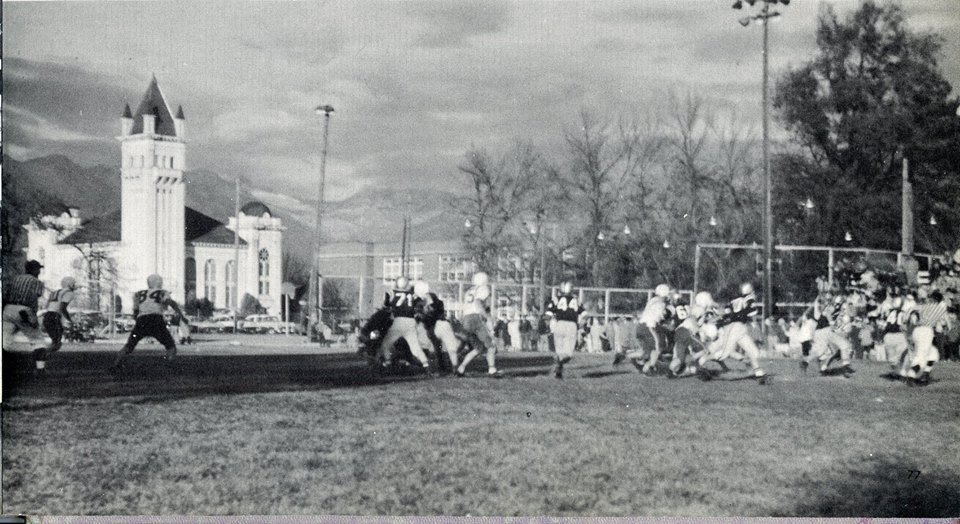
Most tabernacles of The Church of Jesus Christ of Latter-day Saints were built for a large meeting place for a stake organization to congregate in, but Lehi’s was different. Its tabernacle was built because the citizens had outgrown their meetinghouse and the town needed a larger building in which to congregate.[1] The residents of Lehi were relatively poor at the time and struggled to afford the cost of the building. Though the labor was donated, the building materials still had to be purchased. In those days, the local members paid for and provided the labor the new buildings. Because the Lehi Tabernacle was not a stake tabernacle, the bulk of the cost of construction and maintenance fell squarely on the shoulders of the small Lehi congregations.[2] Architect Richard Kletting, who designed the Utah State Capitol, was hired to design the tabernacle.[3]
Although the cornerstone of the Lehi Tabernacle was set in place in 1901, work progressed at a slow pace.[4] Lehi was part of the Alpine Stake at the time, which covered Pleasant Grove, Lindon, Manila, Alpine, American Fork, Lehi and Cedar Valley.[5] In 1904, work on Lehi’s tabernacle ceased when Lehi citizens were called upon to donate money for the Alpine Tabernacle, which was to be built in American Fork, a more centralized location within the stake.[6]
In 1905, there was enough of the Lehi Tabernacle completed that it could be used on a limited basis.[7] It took another five years to complete it. In 1910, while many Lehi residents were working on, and helping pay for, the Alpine Tabernacle, the Lehi Tabernacle was finally completed and dedicated.[8] Unfortunately, the cost of maintaining the large structure was taxing on the small congregations. Ten years after the tabernacle was completed, the local bishops realized they could no longer afford to maintain the building, so it was sold to the Alpine School District in 1920.[9]
The school district remodeled the basement, transforming the existing five rooms into two, which they used for an agriculture lab and a woodworking shop. The two rooms to the rear of the organ were converted into domestic science and art rooms.[10] The official name of the building became the “High School Auditorium,” though nearly everyone still called it, “The Tabernacle.”[11]
In 1928, the Lehi Stake was created, and the new stake leaders began looking for a building suitable for use as a stake center. They wanted to convert the Smuin Dancing Academy into a stake center, but the Presiding Bishopric would not provide any financial assistance. Things changed in 1929, when the Alpine School District announced it was going to add an auditorium to the high school and would no longer be using the Tabernacle. Stake leaders tried to repurchase the building but after inspecting it, Presiding Bishop of the Church, Sylvester Q. Cannon, declared it “unsuitable” for Lehi’s needs and advised that it would cost too much to remodel it.[12]
The school district instead leased the basement of the Tabernacle to Lehi’s National Guard unit for use as an armory. Later that year in December the building was nearly destroyed when the smoldering cigarette of a guardsman caught the basement on fire. Though the fire department was able to extinguish the fire in less than 30 minutes, extensive damage was done. Thankfully, the building’s large pipe organ escaped significant damage.[13]
In 1931, the school board again approached the stake presidency offering to sell the Tabernacle and its organ for $5,000. Following the previous council from the presiding bishop, the stake leaders turned down the offer. The organ was sold to the Beesley Music Company.[14]
The National Guard had plans to refurbish the Tabernacle, which was falling into disrepair with the windows boarded up and broken, but it could not raise the funds.[15] In 1934, it was reported that Lehi Stake leaders and bishoprics planned again to buy the Tabernacle so they could demolish it and use the building materials to enlarge the First Ward meetinghouse to meet the needs of the stake.[16]
In 1935, a group of boys were playing in the old tabernacle when 12-year-old Loren Powell fell through the main floor into the basement. He sustained two broken wrists and some cuts and bruises.[17] By the early 1940s, the LDS Church owned the entire block again. With the help of the city, the tabernacle was turned into a civic auditorium and gymnasium.[18]
Construction began in 1937. The balcony was removed and the rostrum and its decorative woodwork was replaced with a stage. Bathrooms were added along with nine classrooms, a banquet hall, a modern kitchen, a boiler room and an electric organ. The new auditorium became the cultural center of Lehi where recitals, plays, conferences, high school graduations and countless other functions took place.[19]
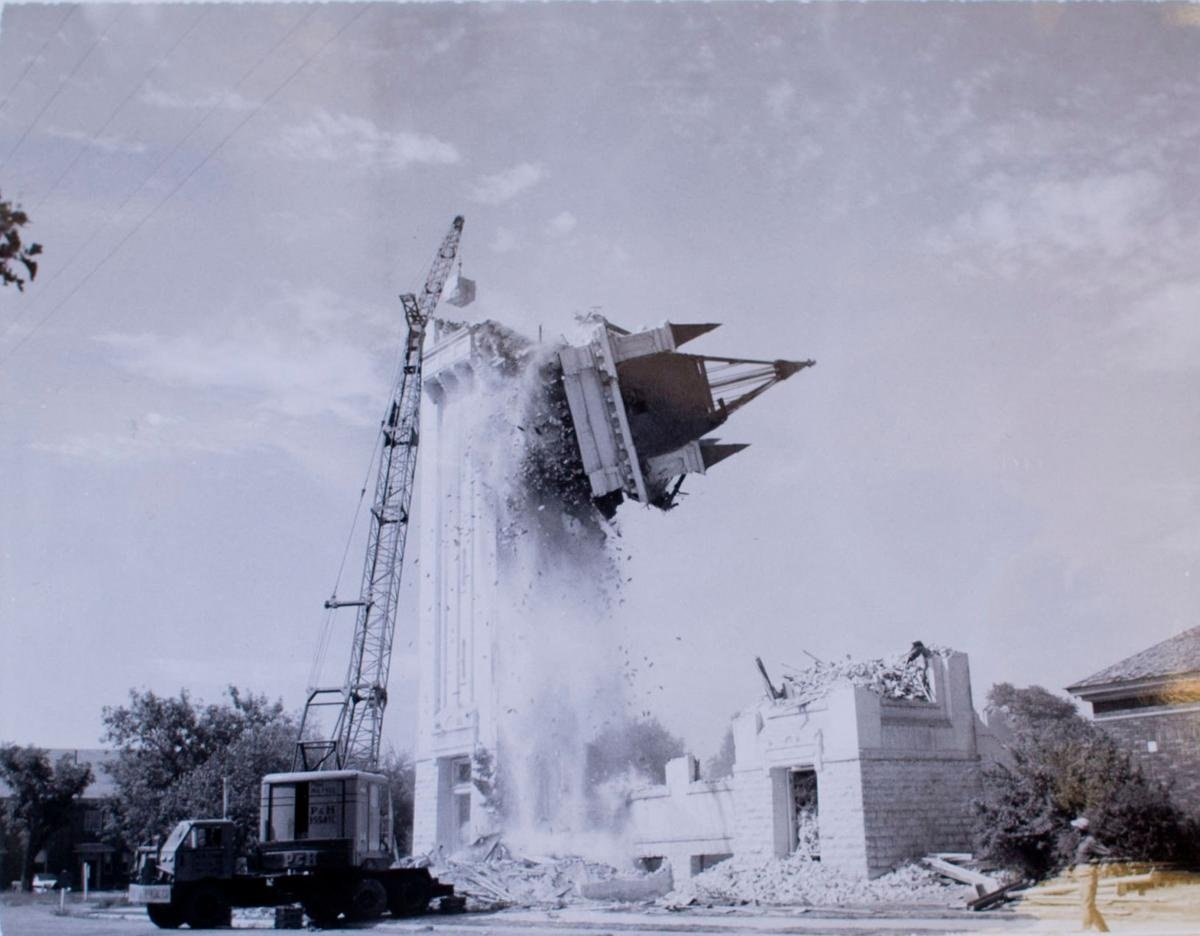
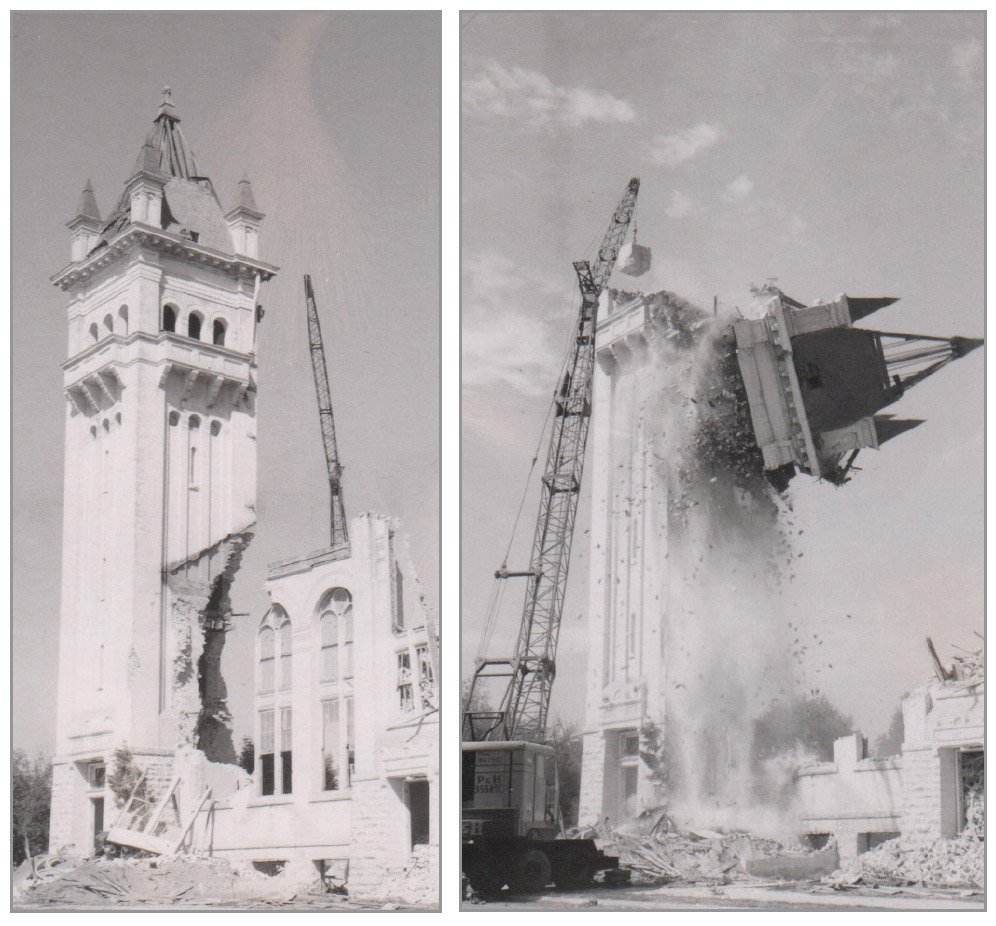
Sadly, in 1961, due to the cost of maintaining the old building and the growing needs of the stake, it was announced that the Tabernacle was going to be razed and replaced with a new stake center. Mixed emotions ran high in the special stake priesthood meeting where the announcement was made.[20] Regardless of the opposition, demolition began in August of 1962. On Sept. 18, a crane with a wrecking ball finished the demolition.[21] Today, there is very little remaining of the Lehi Tabernacle. The cornerstone has been preserved through the years and can be seen at the Lehi Historical Society building.
[1] Lehi Banner 1900-01-25 Page 1
[2] Lehi Banner 1902-05-08 Page 1
[3] Lehi Banner 1900-02-08 Page 4
[4] Lehi Banner 1901-09-19 Page 1
[5] Encyclopedic History of the Church of Jesus Christ of Latter Day Saints page 14
[6] Lehi Portraits of a Utah Town page 103
[7] Lehi Banner 1905-09-07 Page 1
[8] Deseret Evening News 1910-05-14 Page 22
[9] Salt Lake Herald Republican 1920-01-09 Page 7
[10] Lehi Portraits of a Utah Town page 104
[11] Lehi Sun 1920-10-14 Page 1
[12] Lehi Portraits of a Utah Town page 104
[13] Salt Lake Tribune 1929-12-17 Page 4
[14] Lehi Portraits of a Utah Town page 104
[15] Lehi Free Press 1934-03-01 Page 1
[16] Lehi Portraits of a Utah Town page 104
[17] Pleasant Grove Review 1936-07-17 Page 8
[18] Lehi Free Press 1935-09-19 Page 1
[19] Lehi Portraits of a Utah Town page 105
[20] Lehi Portraits of a Utah Town page 105
[21] Lehi Free Press 1962-09-20 Page 1
200 N Center St Lehi, Utah 84043
MARKER LOCATION