Lehi Bandwagon Park
Since 1913
It was around 1886-87 when some members of the YMMIA (Young Men's Mutual Improvement Association) decided to organize the Lehi Silver Band. George Goats was the president, William Goats was the financial adviser and Joseph Kirkham was the band leader. The original members were, George Goats, John Y. Smith, Isaac Taylor, Andrew B. Anderson, Joseph Kirkham, Samuel Taylor, William Goats, George A. Smith, Thomas A. Taylor, James M. Kirkham, Walter Webb, David Jones, Samuel I. Goodwin, Jack Jones, Daniel Fowler, Franz Salzner, William T. Taylor, Charles Gray, Thomas Clark, and Andrew Fjeld.
Each of the members were responsible for purchasing their own instrument and becoming proficient in playing them. Andrew B. Anderson remembered, "The hours for individual practice was any time of the day or night, and the place was any nook of corner permitting the racket." William T. Taylor, while attending BYU, found himself confined to the cow barn to practice his clarinet. Before long the band was marching the streets of Lehi with the townspeople lining up to hear them.
As the band's popularity grew they realized they could perform for more people if they became mobile. Seats were provided in a hay rack wagon which was pulled by four horses. On holidays the wagon was decked out with bunting and flags and took them throughout the city while they performed for about three hours. After using the hay rack for some years they began talking about getting a better bandwagon.
In the fall of 1890 William Goats was visiting the state fair in Salt Lake City. He was attracted to the crowds admiring the running gears of a wagon that was on display by the Bain Wagon and Machine Co. The wheels in William's mind began turning trying to figure out how to acquire those running gears for their new bandwagon. He argued that there was no better advertisement for the Bain Wagon display than on their bandwagon. His argument was a winner and soon the running gears were on their way to Lehi. In 1891, the wagon box was built by master carpenter Gay Whipple in Jacob Hodge's blacksmith shop. The new wagon was given a piano finish and placed into service.
The new bandwagon was much better than the hay rack wagon the band was using previously. They performed for the public every holiday and occasionally in the evenings. During their evening performances some of the towns young men were enlisted to carry torches to provide light.
Edwin Evans was a well known Lehi Artist who had painted murals in both the Cardston and Salt Lake Temples. They hired Edwin to paint the bandwagon. AB Anderson remembered, "Neither time, labor nor expense were to be in the way. A painting of this kind could not be measured in hours, days, or weeks, as each coat of paint must dry and be polished to shining gloss." Edwin painted a beautiful green mural to match the band's dark green uniforms that were trimmed in black.
In April 1895 the Lehi Banner was given a preview of the new bandwagon and they reported, "Yesterday we were shown the most beautiful and exquisite painting, both in design and workmanship, we have ever seen in Utah. It is the painting of the band wagon belonging to the Lehi Silver Band by artist Edwin Evans and Geo. Van Akestein of our city. The box is in gilt and gold leaf, having on each side two mythological figures, or what some would style mermaids. At the back is a figure of a satyr. On the side is Lehi Silver Band in silver leaf. The wheels are painted in cream color and the irons are covered in silver leaf. Mr. Evans is the designer and has done the artistic work which is lovely and exquisite in the extreme, and will be, when seen by the public, admired by all, for it is a thing of beauty the like of which cannot be seen anywhere in Utah."
It was a gala day on May 1st when the new painted band wagon made its first public appearance. The streets were lined with Lehi's citizens who had come out to see it. It was a big hit with most people, constant clapping and shouts of hurrah could be heard as the wagon moved along. Some of the women however, were not impressed. The object of their disapproval was the mermaids who were portrayed in all their glory (without the seashells). There was quite a bit of talk around town for some time afterwards. Phrases like, "You might have expected something like that from those boys", and "Those band boys should be made to put skirts on the mermaids", some of the women even wanted to run the boys out of town.
Despite the objections, the band wagon gradually became known throughout the state as an object of beauty. Other towns requested the band to perform in their parades. During the Sage Brush Democracy political campaign, some of the candidates used the band wagon to campaign in every city in Utah. Unfortunately, there wasn't a good place to store the band wagon so it was usually exposed to the weather. By 1913 Evans' artwork was wearing away and had to be painted over. By 1949 the old band wagon was worn out. It was in need of major repairs, placed in the far corner of the Rodeo Grounds, and nearly forgotten.
In 1952 the band wagon was restored and brought back into service. Over the years the old wagon was used on special occasions and in every parade but the years were wearing on it. It had to be repaired many times and in the 1970s, every time the wagon was used, Lehi City crews had to take the wheels off and soak them thoroughly in a nearby creek so they would not crack while they were being used the next day.
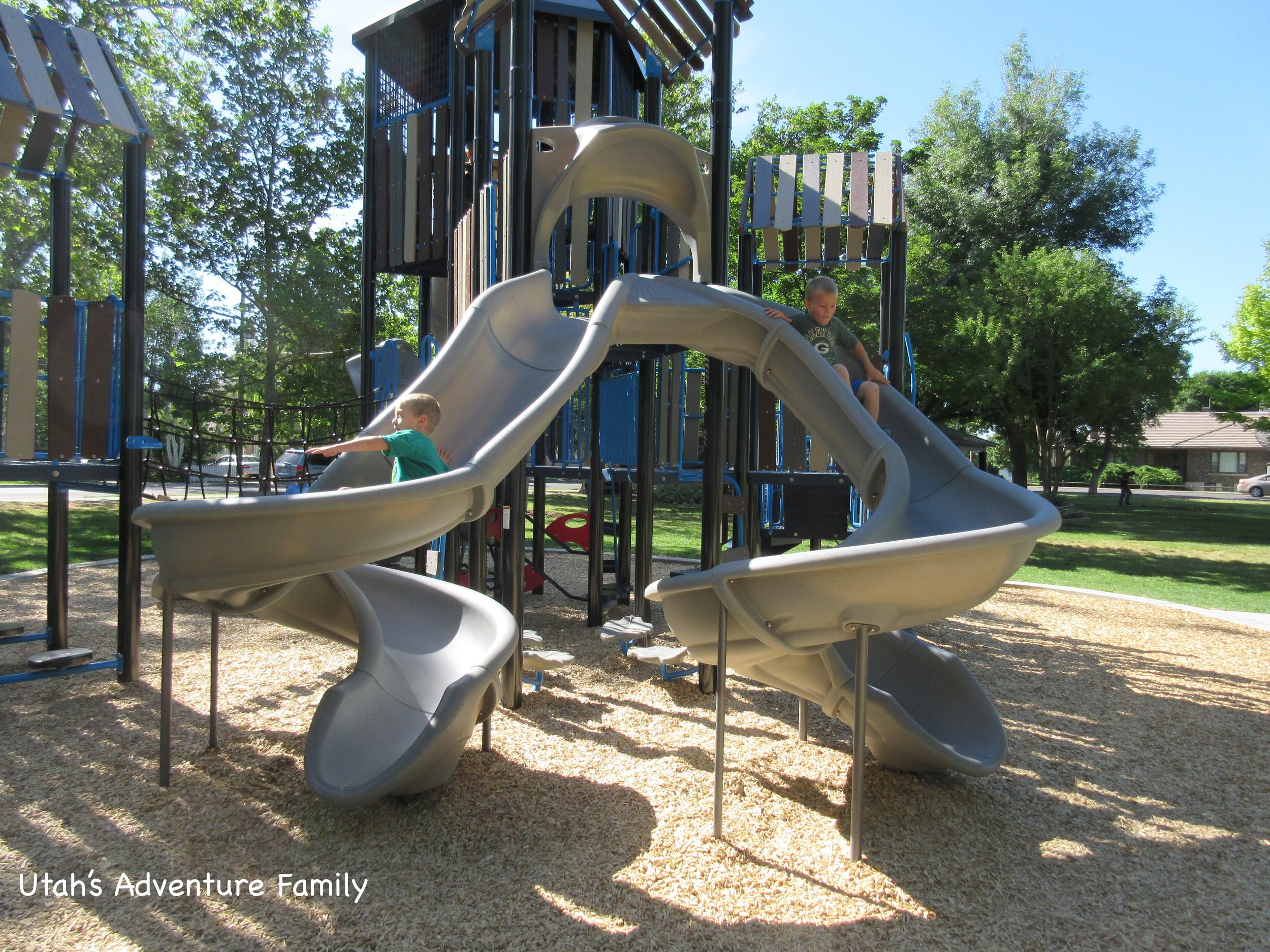
Finally in 1976 the old wagon was retired. As a Bicentennial project, bandwagon park was created with help from volunteers from the community. The park located at 900 north 200 west, contains a pavilion, a playground and a structure designed by Lehi High School junior Dennis Norman to house the historic bandwagon. On July 24, 1976, the Lehi Bandwagon made its final performance in the Days of ‘47 parade carrying the Silver Band. After the parade, the bandwagon was brought to the new park where the band played several numbers for the last time from aboard the 85 year-old bandwagon. After the dedication of the park, the bandwagon was pushed inside the fenced structure where it can be seen today.
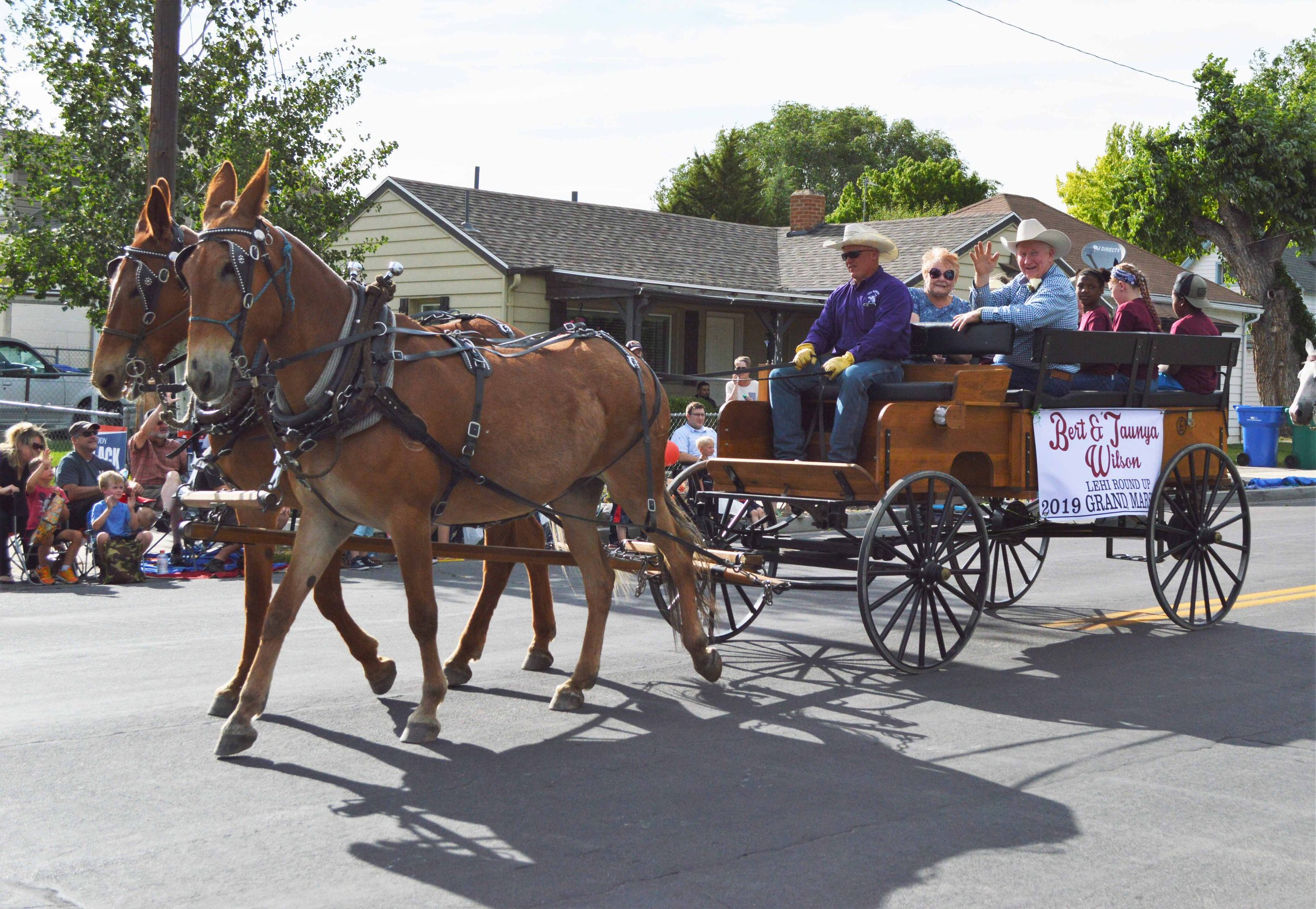
Over the next two decades there was talk of bringing the wagon out of retirement or building a new one. The Silver Band was brought back without their famous wagon but it wasn't the same. Finally in 1997, a new bandwagon was built to carry on the tradition. The woodworking skills of Melvin Anderson was called upon to build the new wagon.
Melvin patterned the new wagon after the original one with a few exceptions. He built the box bigger so there was more room, (he remembered almost being dumped out of the back of the old one a few times), he had rubber added to the wheels so it would be a smoother ride, and he added cushions to the seats. Whenever he came across a problem and wasn't sure how to do something, an idea would usually come to him during the night and stay with him until he had the problem solved. The new wagon was completed in time for the city's Sesquicentennial celebration of the pioneers entering the valley and made its debut in the stock parade during the 1997 Lehi Roundup. The Lehi Silver Band has been an important part of Lehi history for over a century and hopefully they and the new bandwagon will thrill crowds for another century or more.
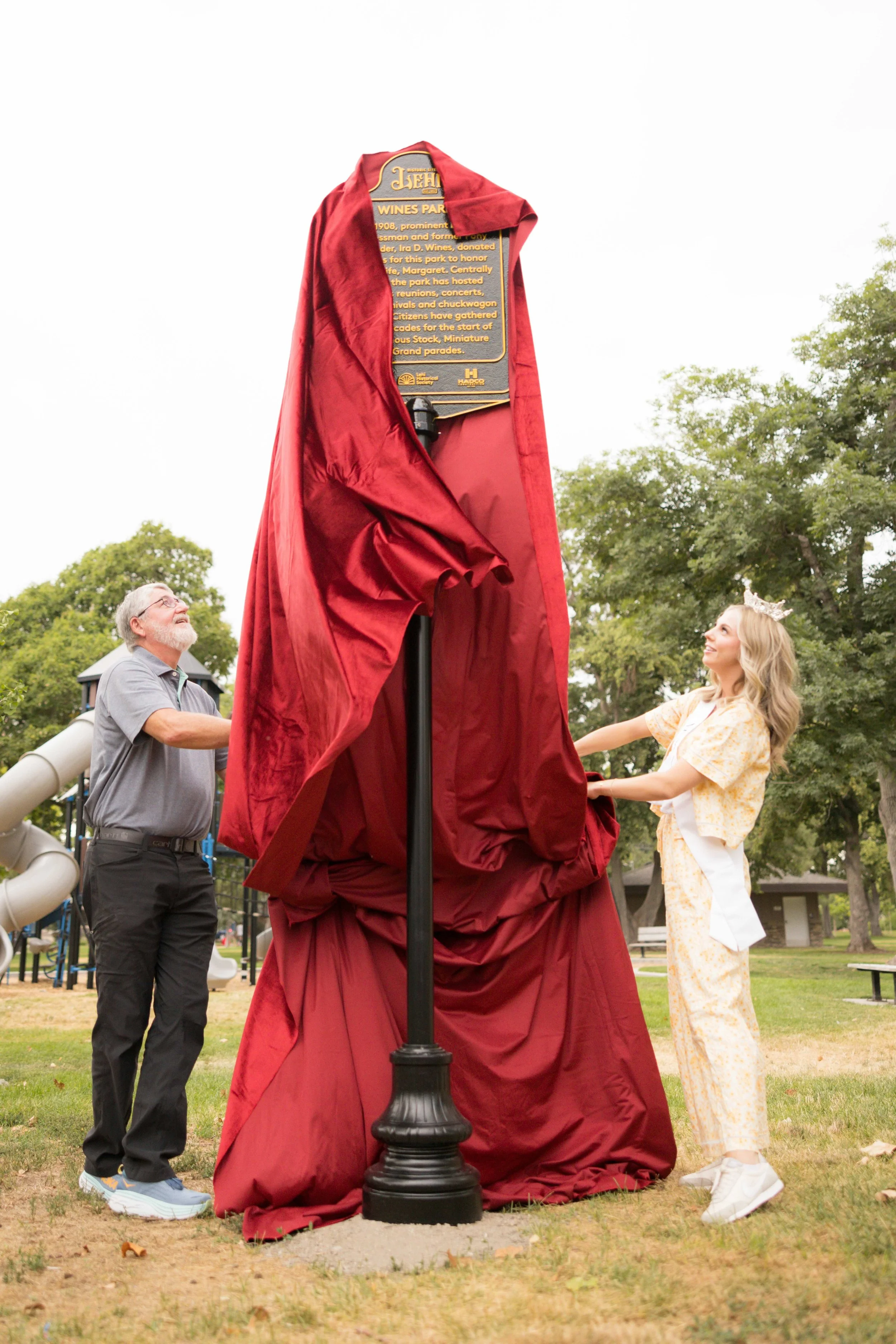
Margaret Wines Park Historical Marker Unveiling
July 18, 2024
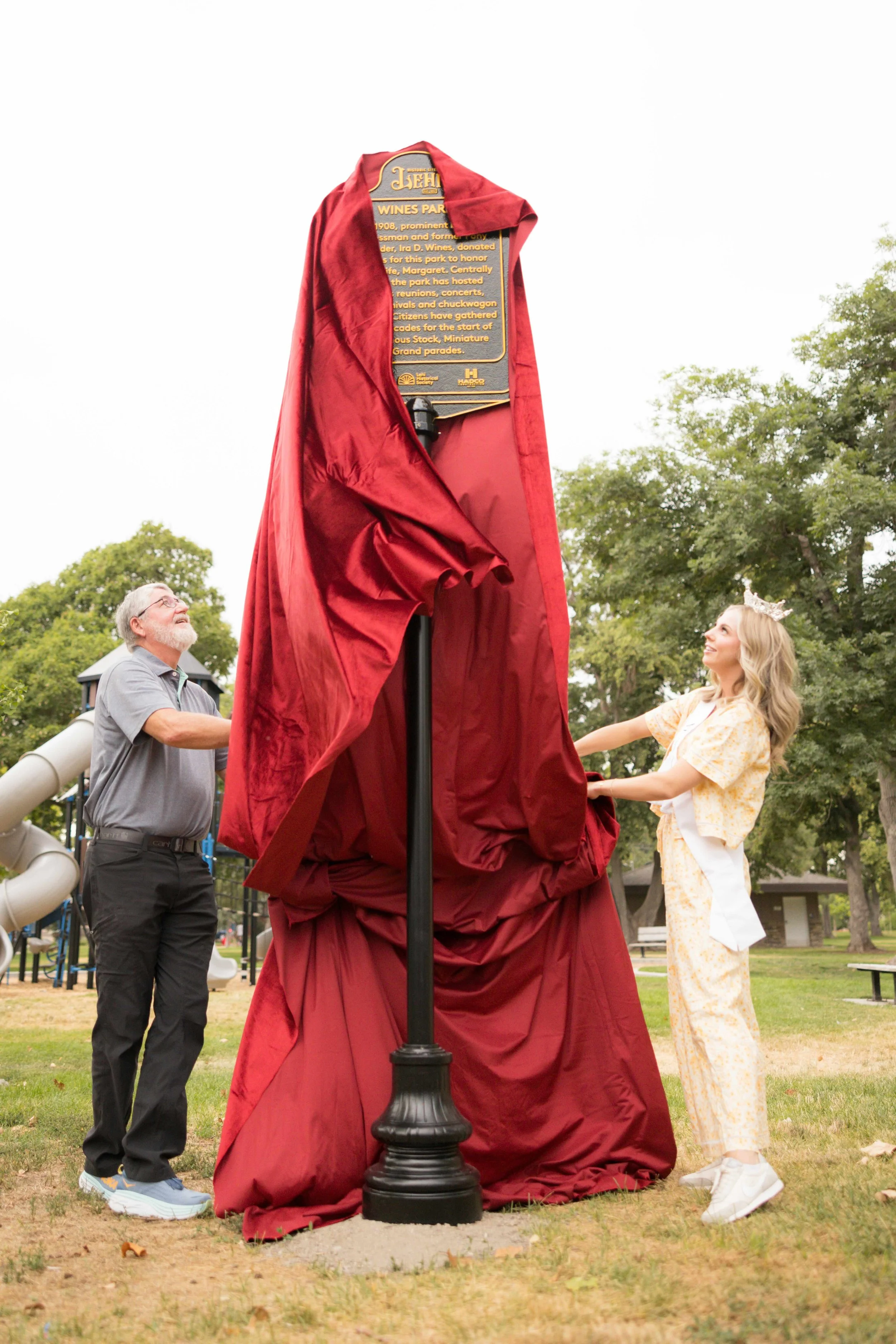
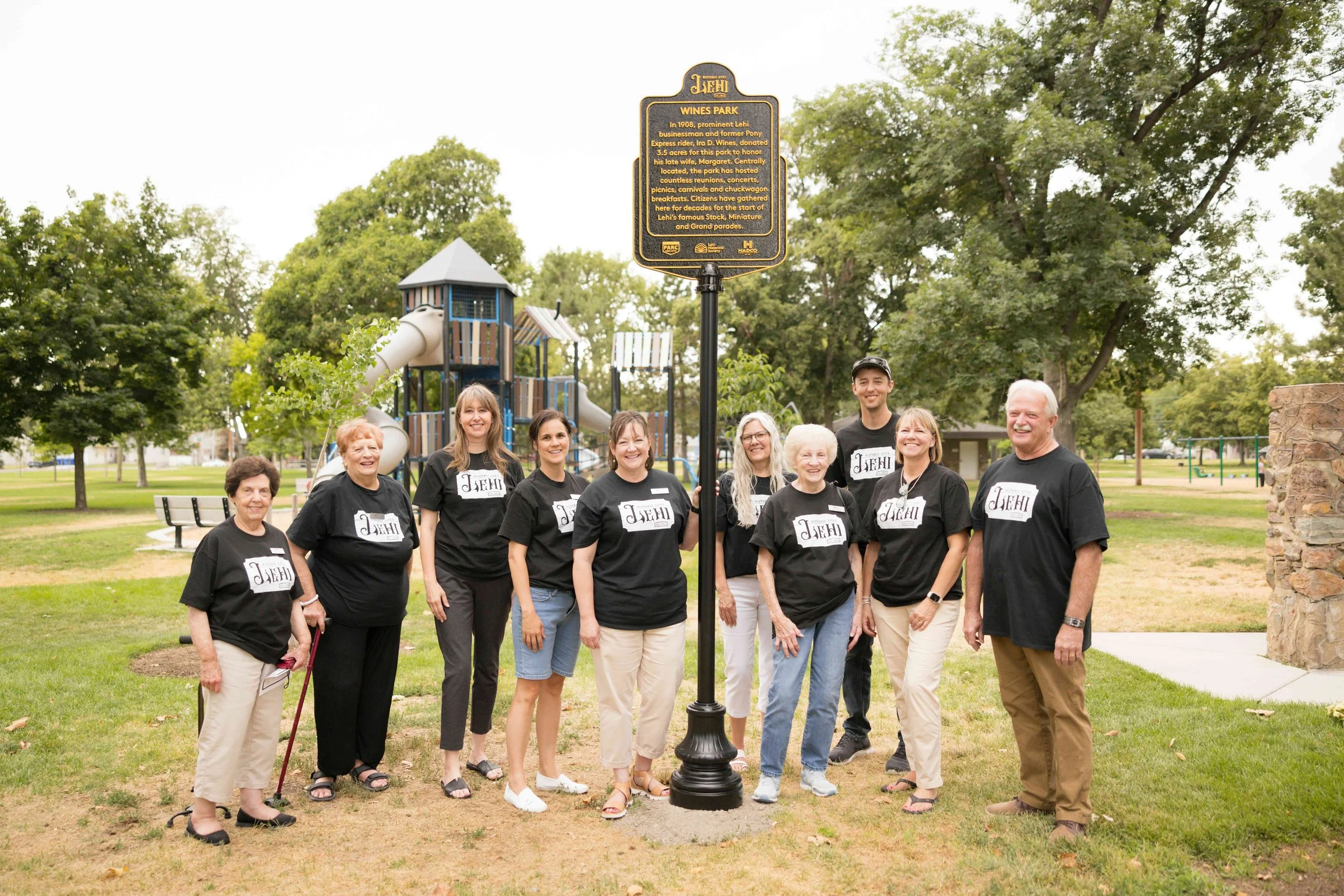
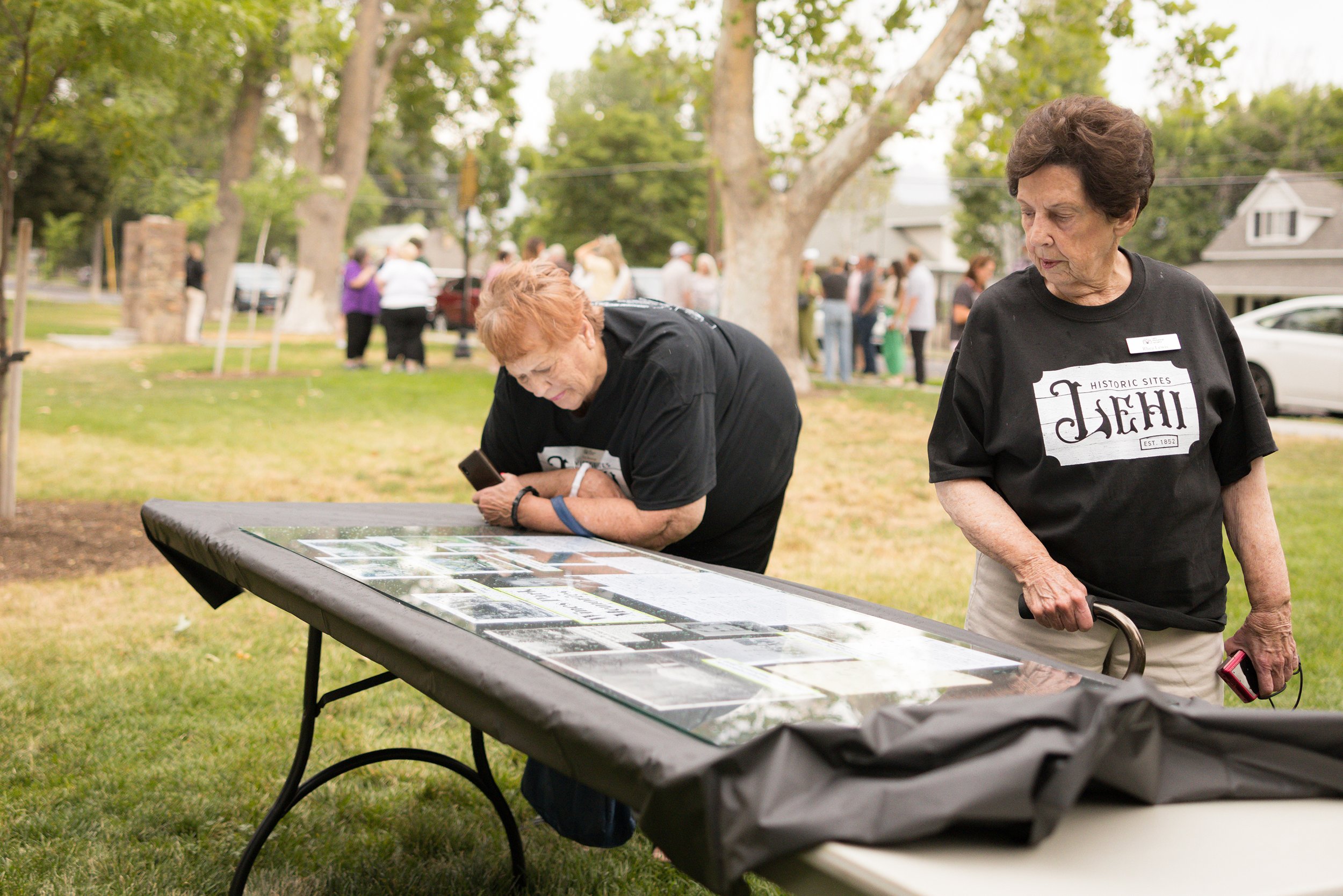
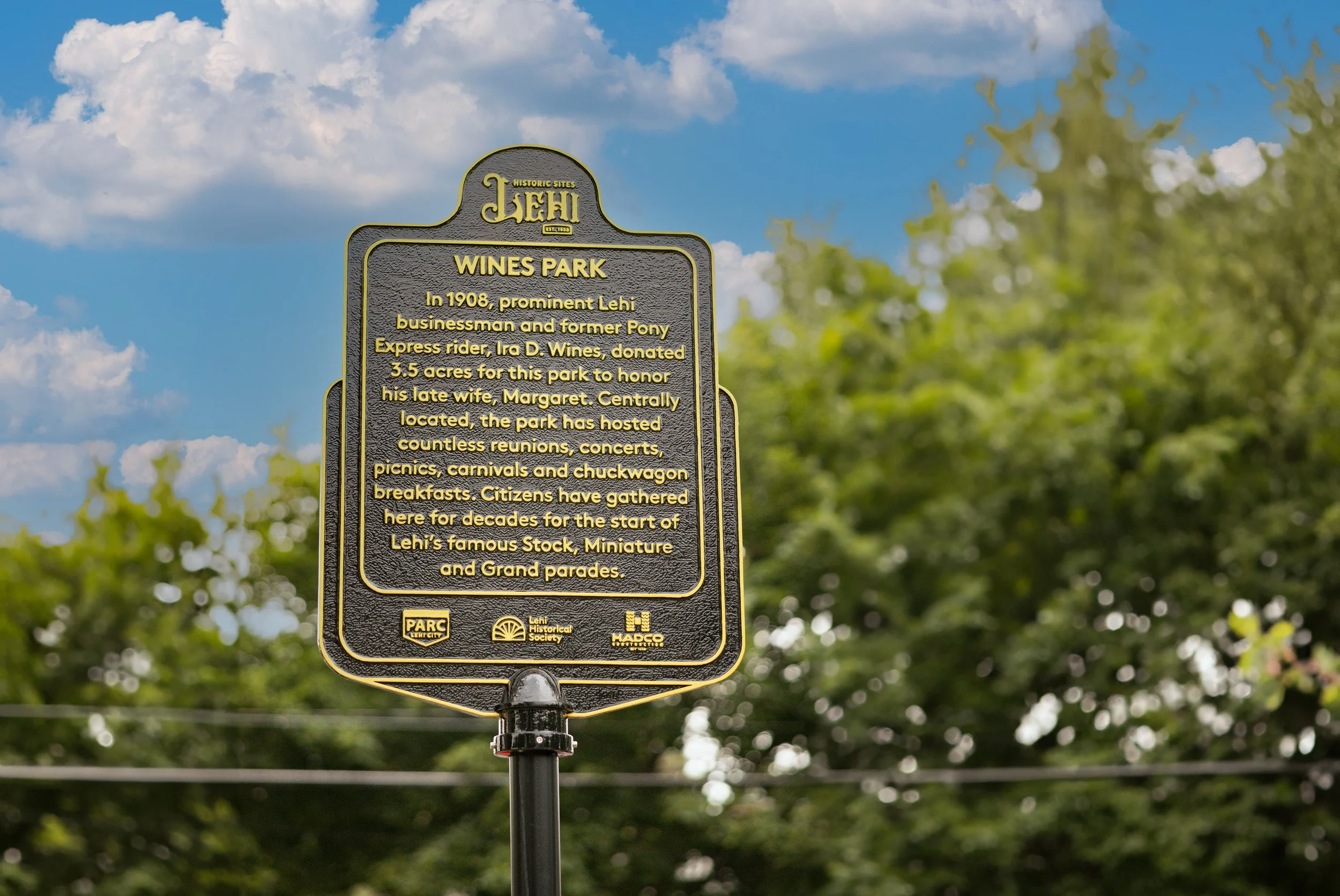
Fifty people gathered to honor Margaret Wines Park, Lehi’s oldest existing park and center of many Lehi celebrations. The park was created in 1908, when Ira D. Wines gifted the land to the city if it would maintain it as a park in honor of his late wife, Margaret. The park is Lehi’s oldest existing park and the center of many of Lehi’s celebrations.
City Councilwoman Michelle Stallings paid tribute to the many local groups and clubs that have funded trees, playground equipment, rose bushes, fireplaces, tables, concrete platforms and drinking fountains. “Even though this park began as a gift by one man,” she said, “it became a gift by many over the years.”
The marker is the second of the Lehi Historical Marker Program.
-
![]()
Unveiling of the Wines Park marker
-
![]()
Historical Society
-
![]()
Wines Park Historical unveiling event
-
![]()
Wines Park Historical Marker
100 East 600 North Lehi, Utah 84043
MARKER LOCATION