
Racker Mercantile
Est. 1901
200 West Main Street Lehi, UT
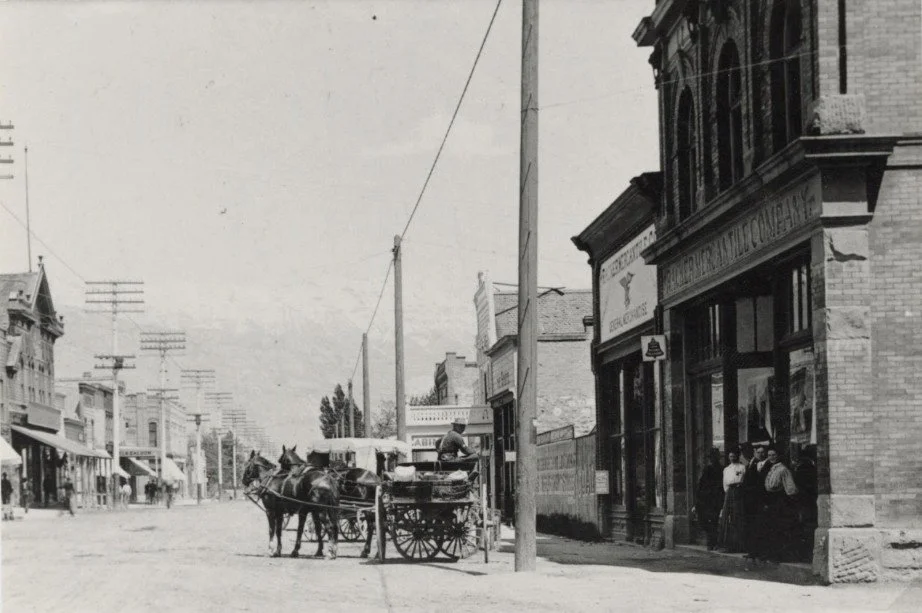
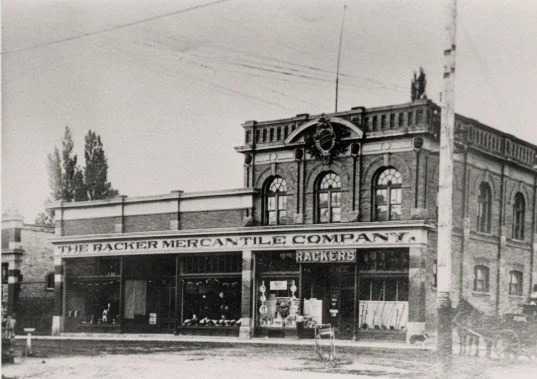
The corner of Second West and Main Street has been a place of commerce for nearly all of Lehi’s history. English brothers Thomas and William W. Taylor established a mercantile firm there in 1858 to facilitate trade with the new U.S. military base Camp Floyd in the nearby Cedar Valley. Although the camp was abandoned with the onset of the Civil War, this was an early example of trade between the citizens of Lehi and the rest of the United States.
A Landmark of Commerce and Community
Prophet Brigham Young urged his members to only trade with other Saints. Inspired by this, and a successful co-op he saw while on his mission in England, Israel Evans convinced his father and other businessmen to found the Lehi Union Exchange in 1868, one of the first in Utah. Using the Union Exchange as an example, Young founded the Churchwide Zion’s Cooperative Mercantile Institution (ZCMI), of which the Lehi Union Exchange would become a subsidiary. This move was made to discourage members from relying on non-member markets. Co-operatives were also intended to be owned by the community, meaning anyone could buy stock in the company and receive dividends. This kept wealth within the community. The Union Exchange was so successful that it put nearly all other merchandisers in town out of business, including the T. & W. Taylor firm, whose business they bought and moved into in 1869.
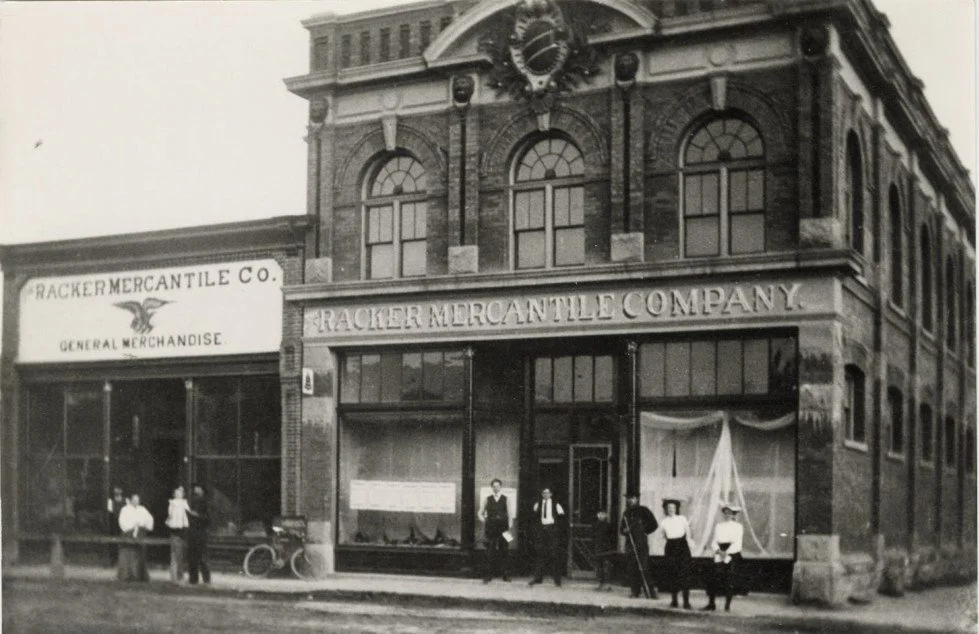
It was not long until other business owners, led by Thomas R. Culter and the Taylors, and with prior knowledge of where the coming railroad would end, created a new mercantile institution called the People’s Co-op in 1872. They opened for business at their location on Second East and State near the railroads. The People’s Co-op eventually bought out the Lehi Union Exchange in 1880. The building at Second West was referred to as “the branch” store. The Church-owned Utah Sugar Company opened its first factory in Lehi in 1890, infusing the entire town with cash. In 1893, Danish immigrant William E. Racker became the institution's superintendent when Thomas R. Cutler stepped down to manage the Sugar Factory. In 1901, the western half of the original building was demolished and rebuilt. Racker managed the two stores until 1903, when he was called on a mission to Denmark. He returned a year later and purchased the Branch store, renaming it the Racker Mercantile Company.
When Utah achieved statehood in 1896, businessmen like Racker abandoned the co-op model to create private enterprises. Racker oversaw success and change. In 1912, the eastern section of the building was demolished and rebuilt, and it was operated as a grocery store. Racker oversaw the company until his retirement in 1922. He left the company to his sons, J.E. and Leonard. They split the store between themselves, though both stores went out of business in 1925, almost certainly due to the Sugar Factory’s closure in 1925. The complex changed ownership over the years, hosting many different types of businesses, reflecting the changing economics and needs of the community. The western part of the building became the LaFeria Reception Center in 1971. There was a fire in 1972 that made local newspapers and was remembered by local townspeople. The entire building was converted to the Colonial House Reception Center when it was bought by Gary Nelson in 1978. Nelson was the longest occupant of the building, owning the property until 2013, when it was sold to Parker Brown Real Estate, which renovated the building into offices.
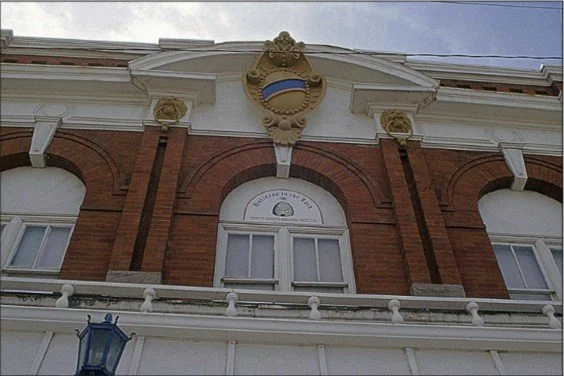
The Racker Mercantile building still stands today and is one of the most historic buildings on Main Street.
Racker Mercantile Through the Years
-
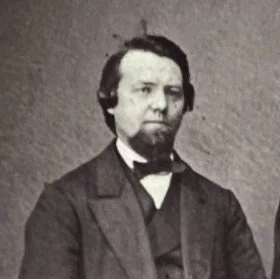
![Thomas Taylor, circa 1863. He and his brother were the earliest successful businessmen in Lehi. FamilySearch.com.]()
1858-1869: T. & W. Taylor and the Lehi Union Exchange
In 1858, the United States Army established Camp Floyd in Cedar Valley, twenty miles from the young Lehi settlement. That same year, two English brothers and converts to the Church of Jesus Christ of Latter-day Saints, Thomas and William W. Taylor, established one of the first stores in Lehi. T. & W. Taylor acted as an intermediary in this trade between the military men and citizens. Wary of becoming too reliant on non-LDS businesses and Eastern markets, Prophet Brigham Young encouraged the Saints to do business only within the community. Inspired by this and an English co-op he saw on his mission, Israel Evans convinced his father, Bishop David Evans, and other investors to found the Lehi Union Exchange in 1868, one of the first co-operative institutions in the state. In 1869, the Church established the Zion’s Cooperative Mercantile Institution (ZCMI), a church-wide co-op. Lehi Union Exchange became one of dozens of subsidiaries of ZCMI that same year.
-
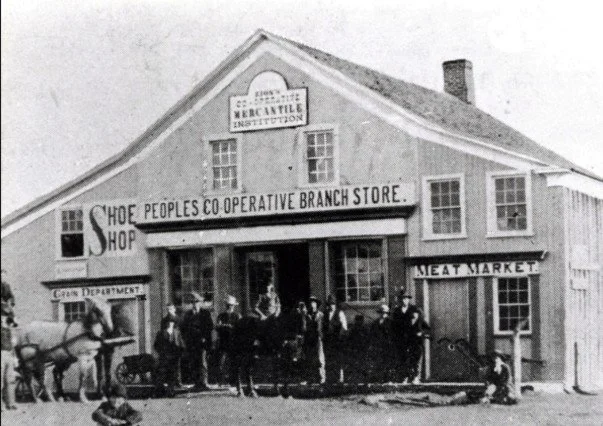
![The People’s Co-op on Main Street circa 1880s. The former location of the Lehi Union Exchange. Lehi Historical Society.]()
1869-1893: The Railroad and the Peoples Co-operative Mercantile Institution
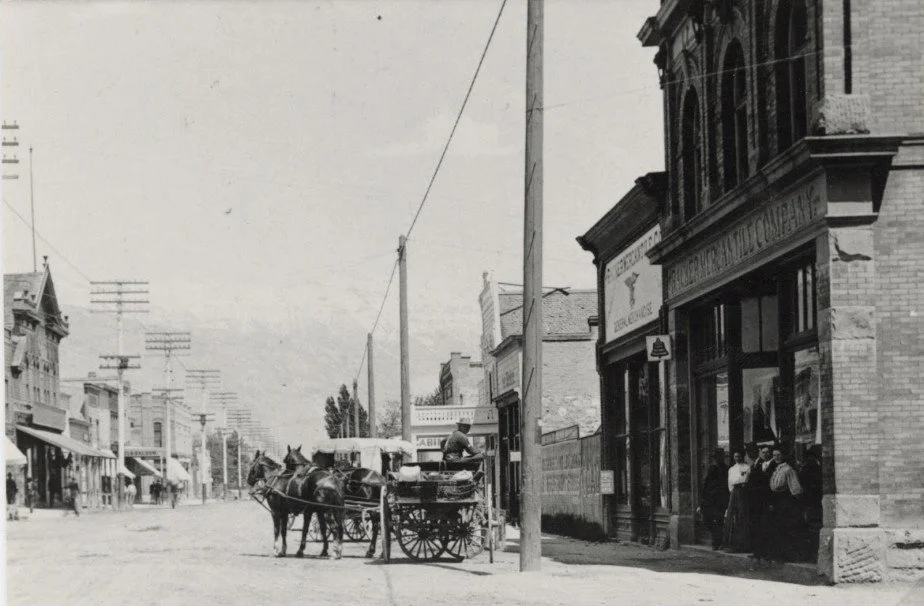
The Exchange’s success led to the closure of most shops in Lehi, and it eventually held a monopoly over the town. In 1869, they bought the store and goods of T. & W. Taylor, moving into their building at the corner of 2nd West and Main Street. Out of business and looking for new opportunities, the Taylors and their former clerk, Thomas R. Culter, predicted the location of the incoming Utah Southern Railroad. In 1872, they established the People’s Co-operative Mercantile Institution to rival the Union Exchange. The two co-ops competed for a decade, but in 1880, the People’s Co-op bought out the Union Exchange. The store came to be known as “the Branch” or the “downtown” location. When the Utah Sugar Company’s Lehi factory was finished in 1893, it flushed the community with cash. Cutler, who was managing both the People’s Co-op and the factory, left his position at the co-op to his long-time superintendent, William E. Racker.
-
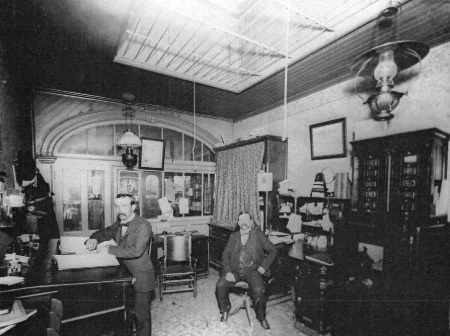
![William Racker (right) in his office at the People’s Co-op, circa 1895. Racker managed both stores before leaving on a mission in 1899. FamilySearch.com.]()
1893-1904: William Racker: Immigrant, businessman, American
William Emil Racker was born on January 23, 1853, in Århus, Denmark. He was baptized into the Church of Jesus Christ of Latter-day Saints when he was fourteen, and immigrated to the United States a year later. He accepted an entry-level bookkeeping job at the People’s Co-op and worked his way up to secretary and treasurer of the company, a position he held for ten years under Thomas R. Cutler. In 1893, Racker was promoted to superintendent of the People’s Co-op while still fulfilling his secretary and treasurer duties. In 1901, the original Lehi Union Exchange building was demolished and replaced by the two-story classic revival building that still stands today. Two years later, Racker was called on a mission to his native Denmark, retiring as superintendent of the co-op in 1903. When he returned a year later, he purchased the downtown store for $9,000, establishing the Racker Mercantile Company in 1904.
-
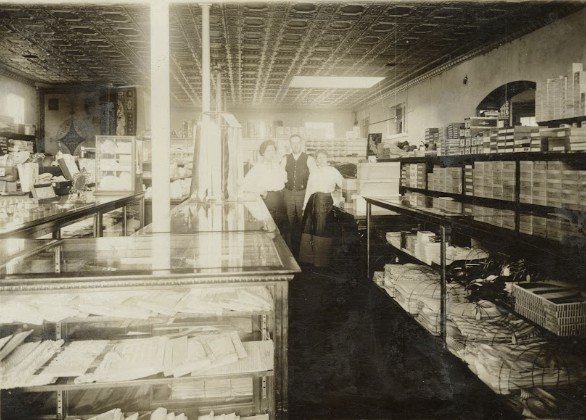
![Interior of Racker Mercantile, 1916. Lehi Historical Society.]()
1904-1922: Racker Mercantile
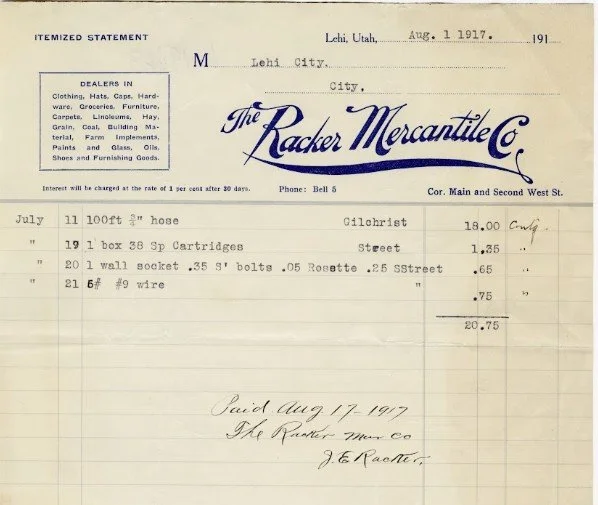
The store’s stock remained similar to its predecessor, selling groceries, hardware, clothing, tools, feed, and lumber. The business was constantly evolving. It catered to new fashion and furnishing trends, evidence of Lehi’s growing connection to the national economy and culture. In 1912, the eastern annex was demolished and rebuilt.15 Racker was involved in many other political and business ventures around town. He served three terms as Lehi City Treasurer, and in 1915, he financed and owned a three-business block on Main Street, just west of Center Street. The three commercial brick buildings were known as the Racker Block, have been home to iconic businesses throughout Lehi’s history. In 2021, the former home of Porter’s Place at 24 West Main was demolished to make way for a modern office complex, also called the Racker Block. The other two-thirds of the block remain and are now occupied by Hidden Gem Studio.
-
![The building after the 1912 eastern remodel. Save for some renovations to the ground floor, the exterior is still recognizable today.]()
1922-1925: The Split of Racker Mercantile
In 1922, the store underwent a significant transformation when it was divided between members of the Racker family. Retiring at 70, William sold his business to his sons Jacob and Leonard, who created two separate retail operations. The eastern portion of the store was renamed to J. E. Racker Mercantile, operated by Jacob, while the western side was operated as the Winchester Store under Leonard Racker. This division reflects both the success of the original enterprise and the challenges inherent in sustaining a family-run business in an increasingly competitive retail environment. This moment also reflects broader national trends in the early twentieth century, as American retail began shifting toward more specialized stores and competitive markets.
-
![Advertisement for “progressive” and “advanced” styles available at the store, 1910. Lehi Historical Society.]()
1925: The End of the Family Business
By 1925, both branches of the former Racker Mercantile had been sold, marking the end of the family business that had once been a central part of Lehi’s Main Street economy. This closure reflects both local and broad economic transformations occurring in the United States during the early twentieth century. The Lehi Sugar Factory, the backbone of the local economy, closed in 1925 due to a sugar beet crop infestation. This pattern of farm closures repeated across the United States, a harbinger for the impending Great Depression. Additionally, the failure of both stores so soon after their division highlights the instability of family-run enterprises during this period of transition. It is also possible that, without William Racker's experience and guidance, his sons were not equipped to manage their business. Racker died the same year his sons sold their businesses at age 72.
-
![Advertisement for Goodwin’s Golden Rule, 1932. Lehi Free Press]()
1926-1961: The National Franchises and the Mixed Use Era
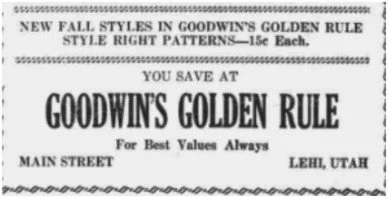
In 1926, the brothers sold their respective stores to other budding businessmen in Lehi. Like William Racker, Samuel Goodwin and Sydney Gilchrist worked in the People’s Co-op organization and decided to strike out on their own. Goodwin opened Goodwin’s Golden Rule in the former J.E. Racker Mercantile building, a national subsidiary of J.C. Penney’s. Both businesses had moved by 1933. Goodwin’s store represented the growing presence of national brands in small towns in the West. With technological advancements, like the radio and automobile, franchises spread across the country. The building reflects this high-paced change with its sheer number of occupants. The buildings hosted regional chains, family businesses, and service-oriented operations. It even served as the National Guard Armory from 1930 to 1941. This adaptability reflects broader patterns in American small towns during the mid-twentieth century, where older buildings were repurposed to meet evolving needs.
-
![The LaFeria Reception Center fire, 1972. Lehi Free Press]()
1961-1978: Change and Disruption
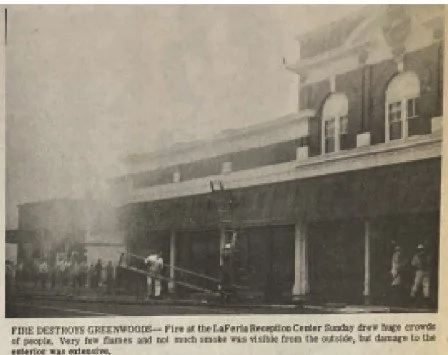
In 1961, grocer Steve Straw bought both buildings and turned them into the Silver Dollar Market, reuniting the structure for the first time in four decades. Ten years later, the building was purchased by the Greenwood family, who turned the western half into the LaFeria Reception Center and opened Greenwood Carpets on the other side. The presence of a reception center suggests a growing emphasis on social and community-oriented functions rather than purely commercial ones. In 1972, a fire broke out in the kitchen area of the reception center. The local community rallied behind the Greenwoods, starting a fund to help pay for damages. In 1978, the Greenwoods sold the building to Gary Nelson, who opened the Colonial House Reception Center. Despite damage and changing economic conditions, the building endured, setting the stage for its eventual restoration and renewed role within the community.
-
![The Colonial House in 1993. The ZCMI plaque harkens back to the building and Lehi’s complicated commercial past. National Parks Service]()
1978-Present: The Colonial House and Modern Era
Gary Nelson was the longest owner and occupant in the Racker Mercantile building. He oversaw the preservation of the building. In 1992, ZCMI donated plaques to some of the remaining subsidiaries. In 1998, the building and other structures in the downtown Lehi area were added to the National Register of Historic Places as part of the Lehi Main Street Historic District. It, along with other notable buildings, was deemed historically significant for its contribution to the early history of Lehi. Though the building no longer served the same function as when it was constructed, it still served the needs of the people of Lehi. After 35 years, Nelson sold the structure to Parker Brown Real Estate in 2013.32 Since then, the building has been converted to office space to accommodate Parker Brown and other businesses. This represents only the latest in renovation, reinvention, and reuse for buildings in Lehi.
The Age of Advertising
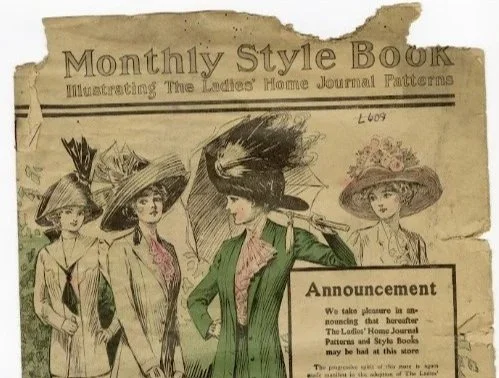
Advertisements and commercial art are full of information beyond telling us about any given item. They tell us about marketing trends, the cost of living, which national events or issues mattered at the local level, and we can learn a lot about race and gender stereotypes. For example, with the 1910 advertisement on the right explaining the new ladies’ fashion and pattern books for sale at Racker Mercantile, we get a peek into what was expected of women and how their clothing was used to express “advancement” and sophistication. This advertisement is for sewing patterns and through the image we can explore how women, regardless of economic status, kept up with national trends. The description given in the “announcement” also allows researchers to learn what national fashion trends were at any given time.
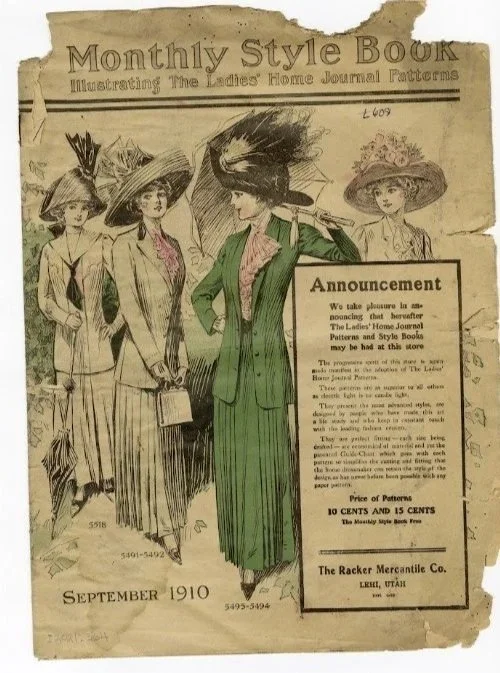
“These patterns are as superior to all others as electric light is to candle light. They present the most advanced styles, are designed by people who have made this art a life study and who keep in constant touch with the leading fashion centers. They are perfect fitting - each size being drafted - are economical of material [...]the home dressmaker can retain the style of the designs as has never before been possible with any paper pattern.”
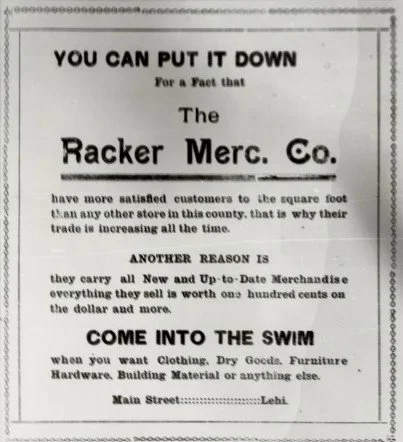
These advertisements also come right around the turn of the 20th-century when we see a big shift in how ads were created. Rather than just text-based listings in local newspapers or magazines, like the one for Racker shown above on the far right-hand side, the rise of nation-wide companies like Kellogg or Heinz led to companies trademarking their ads and thinking of creative ways to get consumers to easily spot their products. With large marketing campaigns by big-name corporations, commercial illustrations became the new standard for marketing products, even at the local-level.
In this video, Mo Rocca visits the Henry Ford Museum’s Curator of Decorative Arts to learn more about commercial art, its impact, and its innovations. In the Racker Mercantile advertisement from 1910 shown above, you can see the influence of the “Gibson Girl” mentioned in the clip.
Marker Location
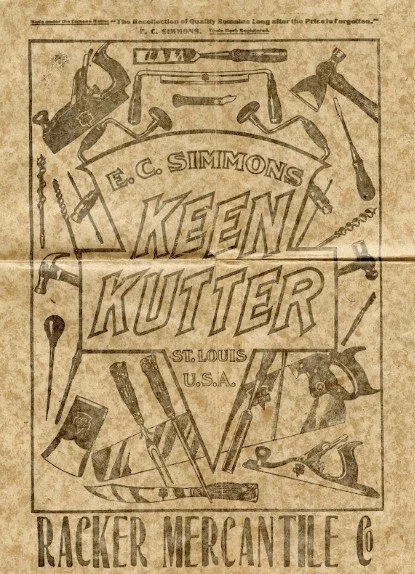
200 West Main Street Lehi, UT
Marker Unveiling
Blurb about Marker Unveiling
-
![]()
Caption
-
![]()
Caption
-
![]()
Caption
-
![]()
Caption




Learn More
Investigate our online archive for more information on Racker Mercantile

Content Contributors
——, Lehi Historical Society
Austen Bergstrom, University of Utah
Nico Genet, University of Utah
Kasia May, University of Utah
Support our Mission
Purchase collector marker pins to show your Lehi spirit! Your purchase will support the Lehi Historical Marker Program and the Lehi Historical Society. There are currently 15 pins available in our gift shop
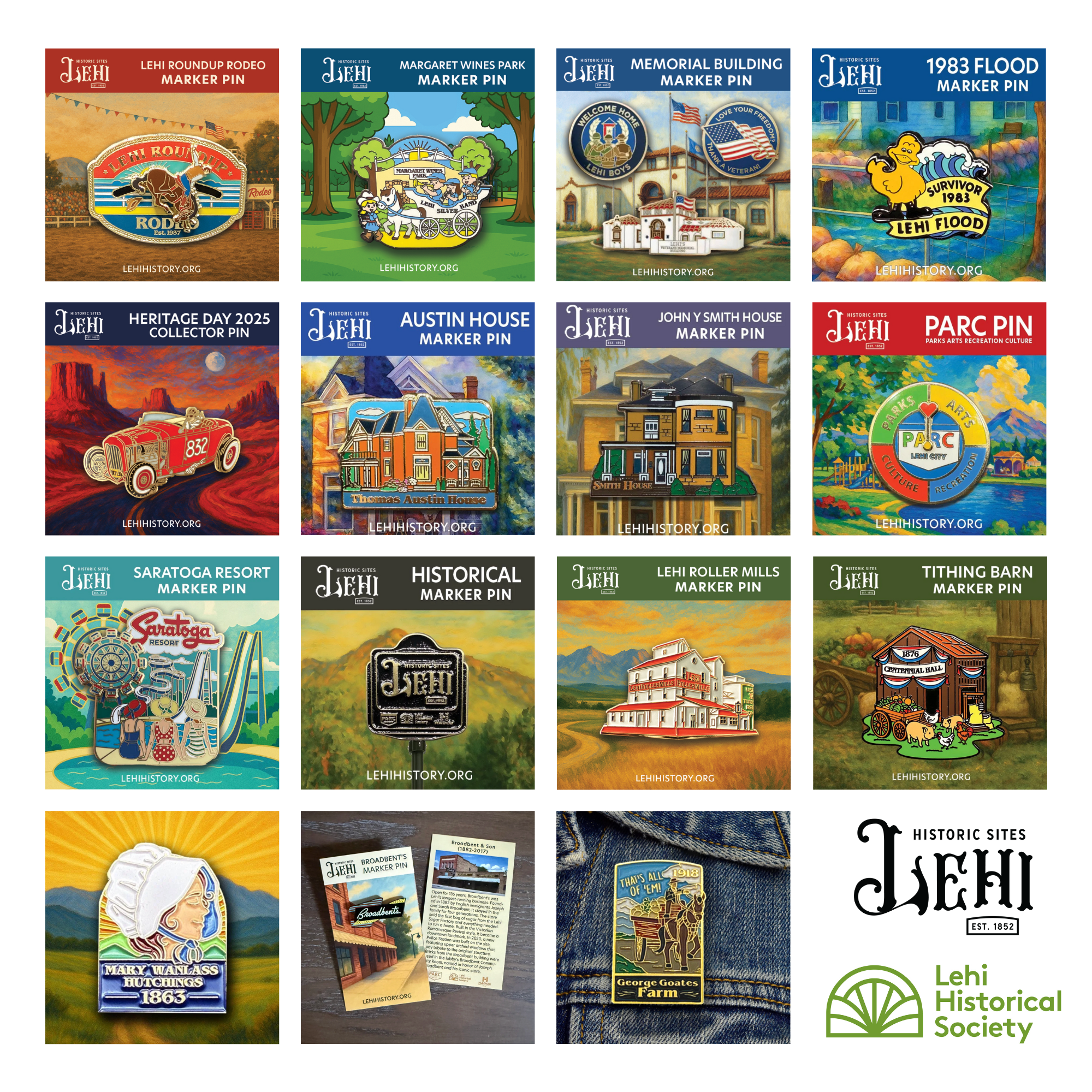
Celebrate Lehi’s history with our complete 15-pin collection. This special bundle includes one of each enamel pin from the Historical Marker Collection.
Pins included in the full set:
• Lehi Roundup Rodeo Marker Pin
• Margaret Wines Park Marker Pin
• Memorial Building Marker Pin
• 1983 Flood Marker Pin
• Heritage Day 2025 Collector Pin
• Austin House Marker Pin
• John Y Smith House Marker Pin
• PARC Pin
• Saratoga Resort Marker Pin
• Historical Marker Pin
• Lehi Roller Mills Marker Pin
• Tithing Barn Marker Pin
• Mary Wanlass Hutchings 1863 Pin
• Broadbent’s Marker Pin
• George Goates Farm Marker Pin
Each pin reflects a real story from Lehi’s past. Landmarks, founders, the rodeo, community legends, floods, and the places that shaped our city. This full set brings together every marker design in one place. It is perfect for collectors, teachers, longtime Lehi families, newcomers wanting to learn the stories behind our city, or anyone looking for a meaningful gift that supports local history.
Take home the complete collection and own 15 pieces of Lehi’s story.

This charming set includes eight full-color greeting cards featuring watercolor-style paintings of historic Lehi locations by local artist Mary Ann Judd Johnson. Each card captures a beloved piece of Lehi’s past, making this set a meaningful gift or keepsake.
Set includes:
Lehi Roller Mills in winter
Lehi Roller Mills in fall
Fifth Ward building of The Church of Jesus Christ of Latter-day Saints
Frank’s UTOCO gas station
Scrooge & Marley’s
The Racker Mercantile Company
Broadbent’s Store
General Refractories
Perfect for writing notes, sharing with friends, or framing as a mini art collection. Each package is wrapped and ribbon-tied, ready to give or enjoy.
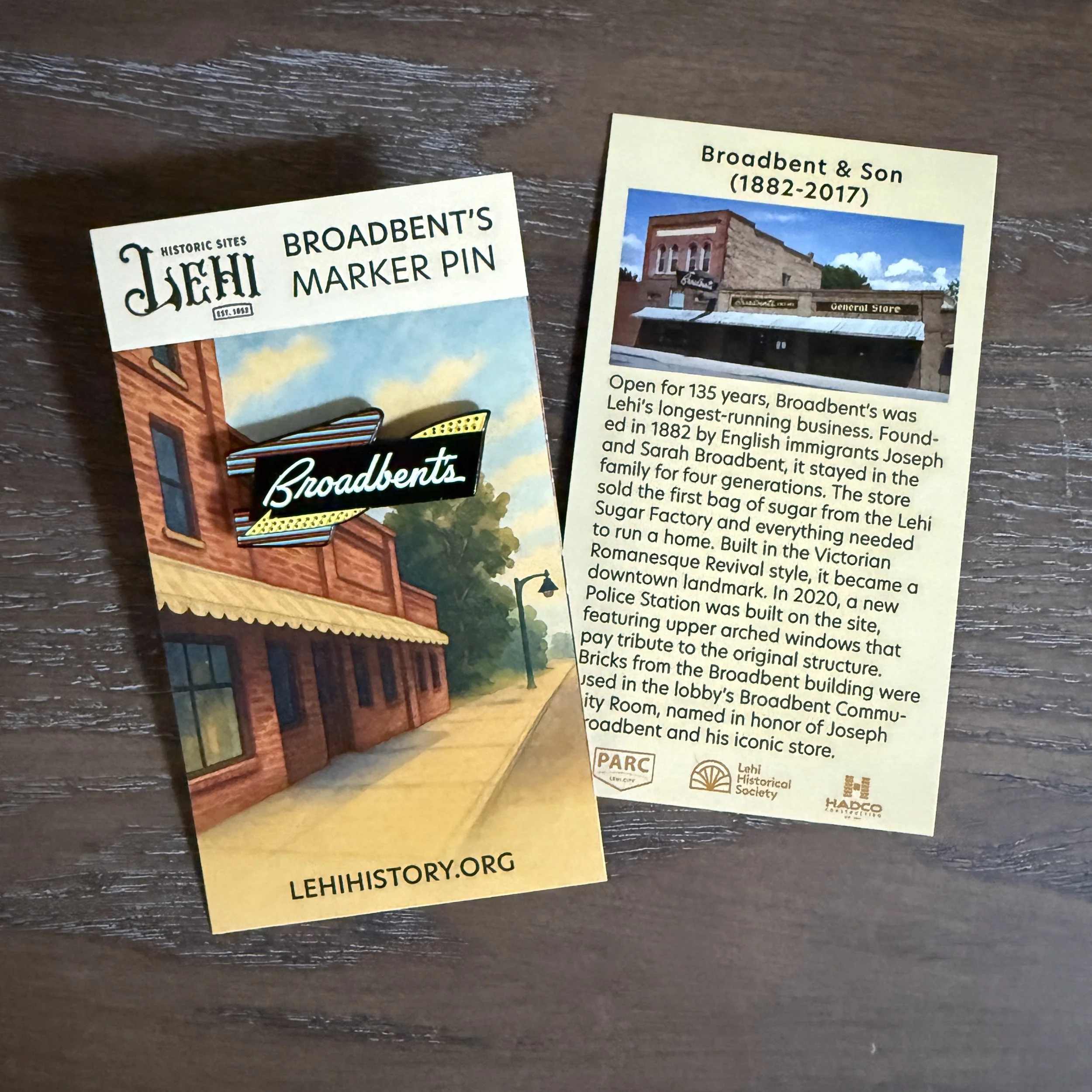
Celebrate a Lehi icon with this Historical Marker collector pin honoring Broadbent’s Store, the longest-running business in Lehi’s history and a cornerstone of the community for 135 years.
Soft enamel with black dyed metal plating
Features the vintage neon Broadbent’s sign installed in 1954
Measures 1.25 inches in length
Single-post backing with secure rubber cover
Perfect for collectors, history lovers, and proud Lehi locals
Founded in 1882 by English immigrants Joseph and Sarah Broadbent, the store was passed down through four generations and became known for offering everything from dry goods to fine fabrics. It sold the first bag of sugar produced by the Lehi Sugar Factory and served as a trusted hub for generations of families. The iconic neon sign, featured in this pin, hung proudly from 1954 until the store’s closing in 2017. Today, the arched windows of the Lehi Police Department pay tribute to the building that once stood in its place.
A nostalgic keepsake celebrating a legacy of service, family, and small-town pride.